

Online parenting courses are everywhere right now. Calmer mornings, easier bedtimes, no more screen battles, all from your sofa with a cup of tea going cold beside you.
Some of them are brilliant. Some leave you with a folder of tips that sound great on paper and fall apart at 7.45am when nobody can find their shoes.
So how do you pick one that actually helps?
I’m a play therapist, and I’m a parent. Here’s what I’d want a friend to know before they hand over their card details.
What kinds of parenting courses are there?
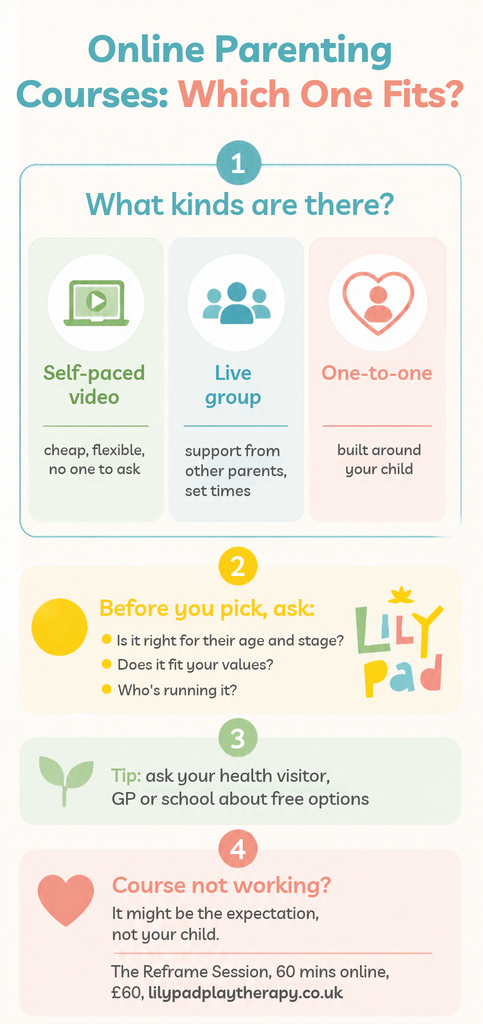
Broadly, three.
The first is the self-paced video course. You watch when you can, usually after bedtime. It’s often the cheapest way in, and great for getting your head around the basics. The downside? Nobody’s there when the advice doesn’t work in your house.
Then there are live group courses. You log on each week with a facilitator and a handful of other parents. There’s something really reassuring about hearing someone else say “mine does that too”. But the sessions run at set times, and the content has to work for everyone in the room.
Finally, there’s one-to-one support online. It’s built around your child, your home and the moments that tip you over. You won’t get a neat twelve-week curriculum. You’ll get help with the thing that’s actually happening.
If you’ve already done a course and it hasn’t stuck, please don’t take that as a sign you’ve failed. It might just have been the wrong format for you.
What should I look for?
Whatever you choose, a few questions are worth asking.
Does it make sense for your child’s age and stage? A lot of frustration comes from expecting a four-year-old to manage things most four-year-olds can’t yet.
Does it sit comfortably with your values? Good support works with your family. It shouldn’t make you feel like you’re parenting someone else’s way.
Who’s running it? Look for proper training. If they call themselves a therapist, check they’re on a professional register.
Will you come away with something you can use tomorrow? Theory is lovely. Tuesday teatime still needs a plan.
Is it clear what you’re signing up for? A course, coaching and therapy are different things. A good provider will tell you which one they’re offering.
Is there anything free?
Sometimes, yes. Before you spend anything, have a word with your health visitor, your GP or your child’s school. Some local authorities give parents free access to courses.
It’s a five-minute phone call, and it might save you a bit.
What if a course isn’t enough?
You’re doing everything you’ve been told to do and it’s still a battle. Somewhere in the background there’s that nagging voice asking whether you’re getting it wrong, or whether something’s wrong with your child.
Often, the real question isn’t how to change the behaviour. It’s whether the expectation was right to begin with.
The Reframe Session
That’s exactly why I created The Reframe Session. It’s 60 minutes to find out if the problem is your child, or the expectation.
We meet one-to-one, online, and look underneath the two or three things you’re finding hardest right now. First, we name your biggest trigger points and what they look like at home. Then we take each one in turn and work out what’s driving the behaviour and where the mismatch might be. We finish with practical next steps you can take away and use.
It’s for parents who are tired of generic advice and have a sneaking suspicion the rulebook doesn’t fit their child (or them!).
Just so you know, it’s parent support, not therapy. It isn’t a clinical assessment, and it isn’t therapeutic work with you or your child.
60-minute online call | £60
Finding the right fit
The best course isn’t the one with the most videos or the biggest promises. It’s the one that fits your child, and you
Recent Comments